ID MOBILE, ensure the reliability of your customer contact data
Control and improve the reliability of data entered using mobile subscriber data.
With ID MOBILE, make the entry of
Mobile subscriber data reliable
With the ID MOBILE module, collecting reliable data has never been as easy. Based on a mobile phone number, ID MOBILE consults French Telecoms operators’ subscriber databases in real time in order to:
- Automatically fill in a form: forms are filled in online with explicit consent by sending an SMS opt-in request.
- Securing online transactions: mobile subscriber data enables to ensure the reliability and veracity of the data input.
- Simple user authentication: using their mobile number, this authentication ensures that contact details are collected in an optimal manner and verified by the operator.
Features
FORM FILLING: Autocomplete of forms via the mobile number
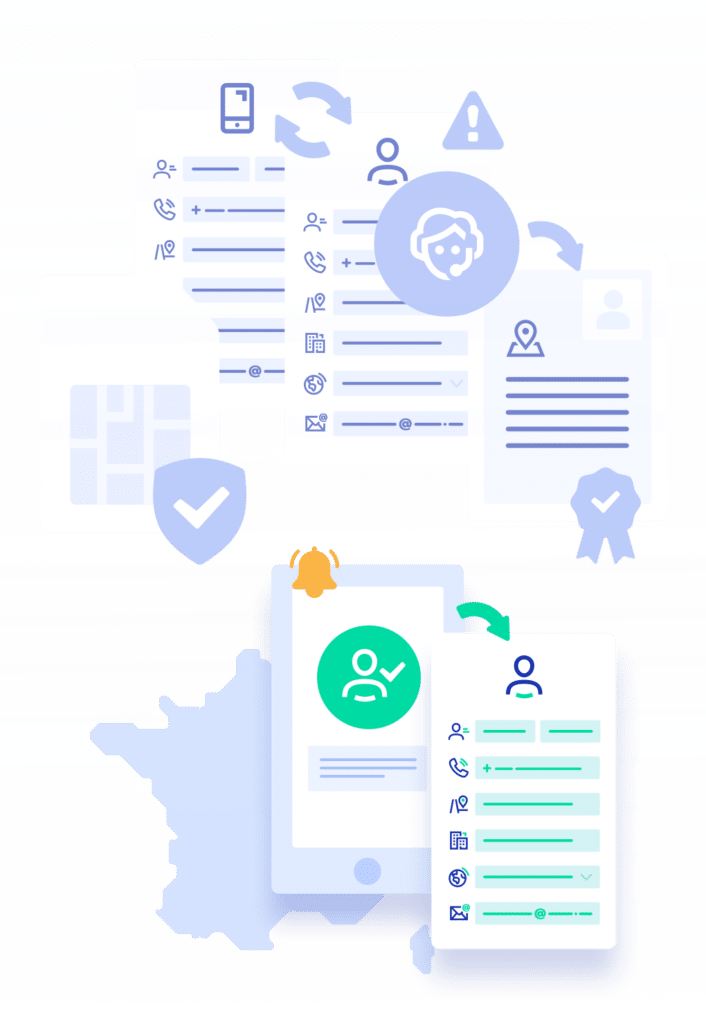
The user chooses to fill in their form by logging in with their mobile phone number. They receive a link by SMS to log in via their mobile phone: by logging in, they authorize their Telecoms operators to share their contact data with the brand. The WEB or CRM form is then filled in automatically.
ID MATCH: Verification of the data entered in a form
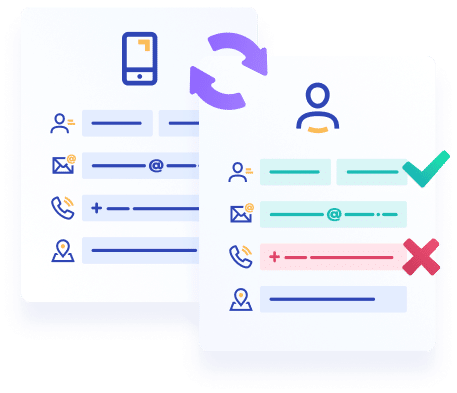
When filling in the web form, the solution checks the consistency and reliability of the data entered by the user in comparison to their customer account data held by the mobile operator.
SIM VERIFY: Verification of the SIM card's age
The solution combats SIM swap fraud and reduces the risk of customer account theft by strengthening authentication processes based on SIM card age.
HOME VERIFY: Sending proof of address

The customer agrees that their Telecoms operator may directly send the requesting establishment their latest phone bill proving their place of residence.
Why equip yourself with the ID
MOBILE module?
More than seven out of ten companies have suffered at least one fraud attempt in the same year. Identity theft is fraudsters’ favorite technique. To protect your company from this well-known type of fraud, it’s better to adopt a solution that enables you to authenticate your buyers with certainty and make their data reliable. You therefore avoid putting in place strong security and verification protocols that slow down the customer journey and increase the abandonment rate.
The benefits of the ID MOBILE module

Fighting fraud
Reduction in the fraud rate for online orders thanks to strengthened identity checks.

Optimized conversion
The obstacles to customer account creation are removed thanks to quick and secure form filling.
Smooth customer journey
Increase in conversion rates thanks to the optimization of customer journeys and the simplification of customer account creation in a few clicks, with no effort.

Good to know
FAQ
What is KYC and why is it required?
KYC (Know Your Customer) is a regulatory process by which businesses verify the identity of their clients before entering into a financial or contractual relationship. It is legally mandated in sectors like banking, insurance, lending, and telecommunications to prevent money laundering, fraud, and terrorist financing. KYC typically involves verifying government-issued identity documents, confirming an individual’s address, and cross-checking against sanctions or watchlists. Failures in KYC compliance can result in significant fines and reputational damage.
How is a mobile phone number used to verify someone's identity?
Mobile phone numbers are increasingly used as a lightweight identity signal because they are tied to a real subscriber identity verified by the telecom operator at the time of SIM activation. By cross-referencing the phone number a user provides against operator subscriber data, businesses can confirm that the number exists, is active, and is associated with a real registered individual — without requiring the user to submit identity documents. This is used in onboarding flows, fraud scoring, and step-up authentication. DQE’s ID Mobile module uses this approach to enrich KYC processes.
What is online identity fraud and how does it affect businesses?
Online identity fraud occurs when someone uses false or stolen personal information to create an account, access a service, or make a purchase they are not entitled to. It affects businesses through direct financial losses (chargebacks, fraudulent claims), regulatory penalties (for failing to detect fraudulent onboarding), and reputational damage. Fraud rates are particularly high at account creation and credit application stages. Combining data validation signals — phone activity, address verification, email legitimacy — at the point of onboarding significantly reduces the window for fraudulent entries.
What is the difference between authentication and identity verification?
Identity verification confirms that a person is who they claim to be, typically done once during onboarding (e.g., checking a passport or verifying a phone subscriber record). Authentication confirms that the same verified person is the one currently accessing a service, typically done at each login (e.g., password, OTP, biometrics). Both are necessary: verification establishes the initial trust baseline; authentication maintains it over time. Weaknesses in either step create fraud vectors.
What data signals are used to detect a fraudulent registration in real time?
Fraud detection at registration typically combines multiple signals: email address validity and domain reputation, phone number existence and recent activity, address deliverability, device fingerprint, behavioral patterns (typing speed, copy-paste behavior), and cross-referencing with known fraud databases. The more signals corroborate each other, the higher the confidence in a legitimate identity. DQE’s ID Mobile module contributes the mobile subscriber signal to this layered approach — one client halved their fraud rate within a year of implementing it.