
AI-Powered Prospecting: How Bad Data Quality Sabotages Your Personalised Campaigns

AI in Cold Calling: Your CRM Isn't Betraying You — Your Data Is
The stakes: turning AI into a performance driver for your sales teams
The proposed solution: handing outbound outreach to an AI agent. It contacts prospects automatically, delivers the invitation, logs their responses, then passes qualified leads on to the sales teams.
- Scaling up without additional resources
- Fast, large-scale outreach
- Sales time refocused on genuinely qualified leads
« Good morning, Madam Procurement Department, we’d like to invite you to our event. »
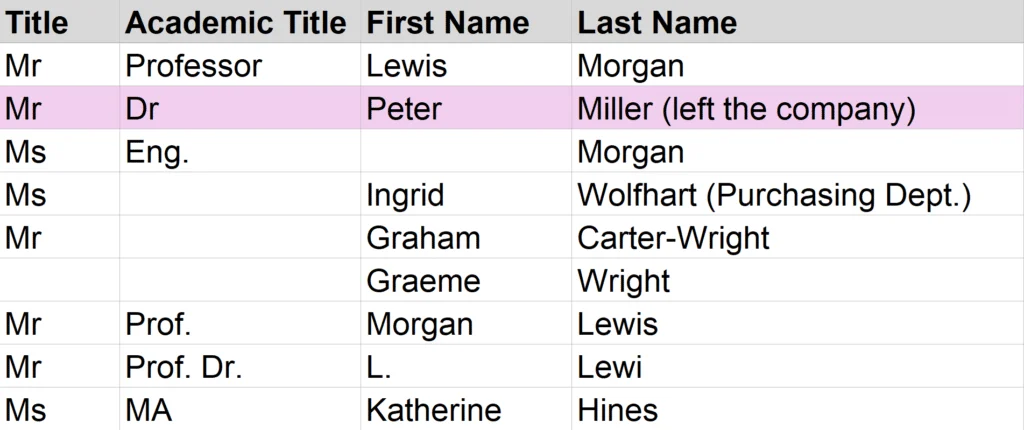
First hiccup: when AI multiplies the missteps
- "Good morning Mr Dr Dupont, former employee"
- "Delighted to reach you, Madam Procurement Department"
Here is an excerpt of data typically found in a CRM database:
Second hiccup: when the invitation never reaches its destination
But in reality:
❌Some contacts simply don’t have an email address on file.
❌The postal address is empty, incomplete or outdated.
❌The name and address are misprinted, even on the most carefully designed invitation cards.
The blind spot: owning a CRM doesn't guarantee data quality
- The email and address fields were never made mandatory at data entry
- Fields are poorly filled in or inconsistent with one another
- Validation rules and data entry standards are lacking
- Company addresses have never been verified, and many of them are incorrect
- Contacts who've left the company were never removed, and job changes were never updated
« AI doesn’t automate processes. It amplifies the state of your data, whether good or bad. »
The solution: data quality as the foundation of AI success
🔧7 actions to implement right now to make your business data reliable:
- 1. Make key fields mandatory: no lead without a valid email or address.
- 2. Standardise data entry: consistent structure for salutation, title (limited to academic titles), name and address.
- 3. Automate validation: real-time field and format checks.
- 4. Clean the database: eliminate duplicates, stray characters and outdated data.
- 5. Verify addresses: postal and legal validity (business registry), with sanctions list screening
- 6. Maintain roles: who's actually the decision-maker? Who's still in post?
- 7. Adapt fields to the AI standard: does your voice agent pronounce titles and salutations correctly?
Your next step: start small, but structure it properly
💡The practical tip:
1. Extract a test sample from your database (for example, 200 contacts).
- Check the salutation, title, first name and surname: completeness and proper field separation.
- Flag special characters, comments slipped into the "surname" field, and abbreviated initials.
- Check for the presence and plausibility of the email address and postal address.
2. Verify the addresses
- Postal compliance
- Business still active on the trade register
- Sanctions or insolvency risk
In conclusion: AI is a multiplier, not a fix for poor processes
Want to get your sales operation AI-ready, built on solid foundations? Our Quickcheck data diagnostic gives you the answer. Let’s talk.
About DQE
Because data quality is essential to customer knowledge and the construction of a lasting relationship, since 2008, DQE has provided its clients with innovative and comprehensive solutions that facilitate the collection of reliable data.

18
Years of
expertise

1,000
Clients in all
sectors

10Bn
Queries per
year

240
International
repositories