DQE One Standalone continues to evolve: discover the latest features
Customer data quality rarely deteriorates overnight. Instead, it gradually declines over time for a variety of reasons: an outdated address, a company acquisition that was never reflected in the data, duplicates that continue to accumulate, or poorly configured data flows between systems. Left unresolved, these issues ultimately lead to less effective marketing campaigns, compliance risks and business decisions based on inaccurate information.
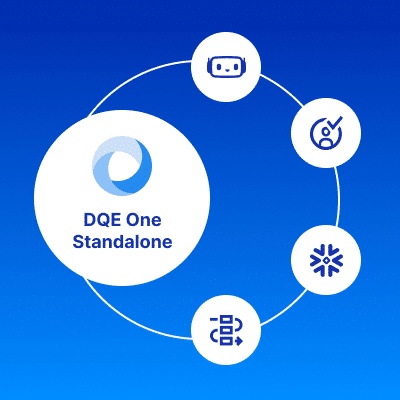
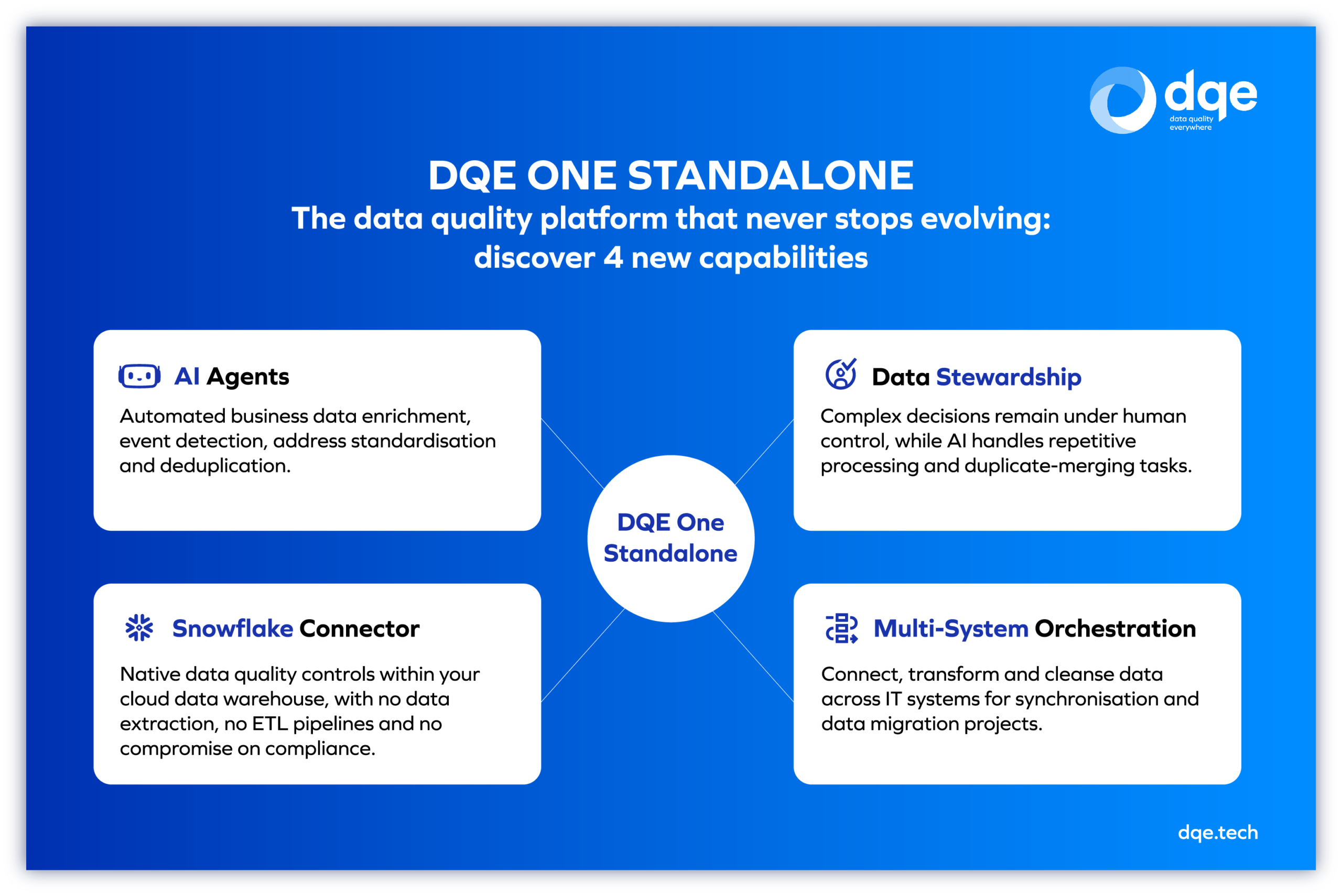
To help organisations address these challenges, DQE has introduced four new capabilities within DQE One Standalone: AI agents that can operate autonomously, a dedicated control module for supervising and managing those agents, a Snowflake connector, and a multi-system orchestration layer designed for synchronisation and data migration projects.
1. An AI Agent Workflow to Improve B2B Data Reliability
B2B databases are particularly vulnerable to certain types of data quality issues: incorrect addresses, multiple duplicates, acquired companies that have not been updated in internal systems, obsolete SIRET or company registration numbers and more. DQE One Standalone now includes a workflow of four specialised AI agents, orchestrated by an analysis agent that examines the uploaded dataset, understands its structure and automatically selects the most relevant agents for processing.
- Company Info Agent enriches each record with official information from legal business registries, including SIRET (company registration number) number, NAF (business activity category) code, legal status and VAT number.
- Company Event Agent detects recent corporate events such as mergers, acquisitions, company name changes and business closures to identify outdated records.
- Address Normalisation Agent standardises postal addresses to comply with the ISO 20022 format.
- Deduplication Agent identifies and removes duplicate records, even when they appear under different spellings or formats.
All customer data processing remains under the user’s supervision. Each recommendation is presented in natural language, accompanied by a confidence score and submitted for validation before any changes are applied.

2. Data Stewardship: Keeping Control of Your Data Decisions with AI Assistance
In a customer data quality project, identifying an anomaly is only the first step. The real challenge lies in making the right decision: should AI be used? How should a complex merge between two duplicate records be handled?
The Data Stewardship capabilities available in DQE One Standalone address these challenges directly by giving data stewards full control over anomaly resolution:
- Free choice of processing mode for each anomaly: either direct manual or automatic. High-confidence treatments can be applied automatically according to defined thresholds, while ambiguous cases are submitted for human validation.
- Use a duplicate merge interface that displays candidate records field by field, allowing users to designate a master record and select exactly which values to retain before validating the merge.
- Activate the deduplication agent on demand, with every recommendation accompanied by a natural-language explanation and a confidence score to support decision-making.
- Ensure complete traceability through a detailed audit log showing actions performed, users involved, the AI agent consulted, its justification, and the timestamp of each decision.
This approach redefines the role of the data steward. AI handles repetitive cases, while teams focus on situations that require genuine business judgement, with full traceability for every decision.

3. Monitoring Customer Data Quality Directly in Snowflake
More and more organisations are centralising their data in cloud platforms such as Snowflake to facilitate large-scale analysis and operational use. However, centralisation alone does not eliminate data quality issues. Duplicate records, outdated addresses and inaccurate information continue to accumulate, while extracting data from the data warehouse for quality checks can increase GDPR compliance risks.
The new Snowflake connector for DQE One Standalone addresses this challenge by enabling data quality monitoring and improvement directly within Snowflake, with no data extraction, no ETL pipeline, and without compromising compliance:
- Automatic table profiling, including structure and content analysis, identification of at-risk fields and instant diagnostics.
- Business rule configuration, covering email and phone number uniqueness, mandatory field completeness, format validation, legal data compliance and duplicate detection.
- Native push-down execution in Snowflake, with rules automatically translated into SQL and executed directly within the data warehouse, eliminating latency and data replication.
- Data quality dashboards providing scores by quality dimension, trend analysis over time, and exportable reports.
This approach helps organisations maintain accurate and reliable databases, improve email campaign deliverability, reduce returned shipments, streamline billing processes, and ensure that customer data never leaves the Snowflake environment.

4. A Single Interface to Connect, Transform and Cleanse Data Across Systems for Migration and Synchronisation Projects
In organisations, data constantly flows between CRMs, e-commerce platforms, ERPs and data warehouses. With every migration or synchronisation project, data teams face the same challenge: source and target systems rarely speak exactly the same language.
Until now, data migration typically required two separate tools: an ETL solution for data transformation and a data quality solution for data cleansing. DQE One Standalone now brings both capabilities together in a single interface to:
- Manage multiple data flows from a single control point, supporting as many source-to-target combinations as required without multiplying tools or licences.
- Configure reusable visual mappings between source and target fields, including field renaming, merging, splitting and converting structures. Mappings can be saved and applied automatically to future data flows.
- Apply data quality controls in transit rather than after migration, ensuring records are verified and corrected before reaching their destination.
- Maintain complete traceability for every data flow through dedicated logs that record what data was transferred and which transformations were applied. With the integration of Data Stewardship in DQE One Standalone, users also see the before-and-after of every change.
This approach reduces tool sprawl, minimises errors caused by manual mappings, and helps ensure data consistency across systems.

A platform designed to empower data teams
DQE One Standalone now combines AI agents capable of addressing specific challenges in minutes, a dedicated human oversight framework for governing their actions, direct access to data quality within the Snowflake cloud data platform, and a unified orchestration layer bringing together ETL and data quality for migration and synchronisation projects.
Would you like to discover DQE One Standalone?
About DQE
Because Data quality is essential to customer knowledge and the construction of a lasting relationship, since 2008, DQE has provided its clients with innovative and comprehensive solutions that facilitate the collection of reliable data.

18
Years of
expertise

1,000
Clients in all
sectors

10Bn
Queries per
year

240
Internationnal
repositories